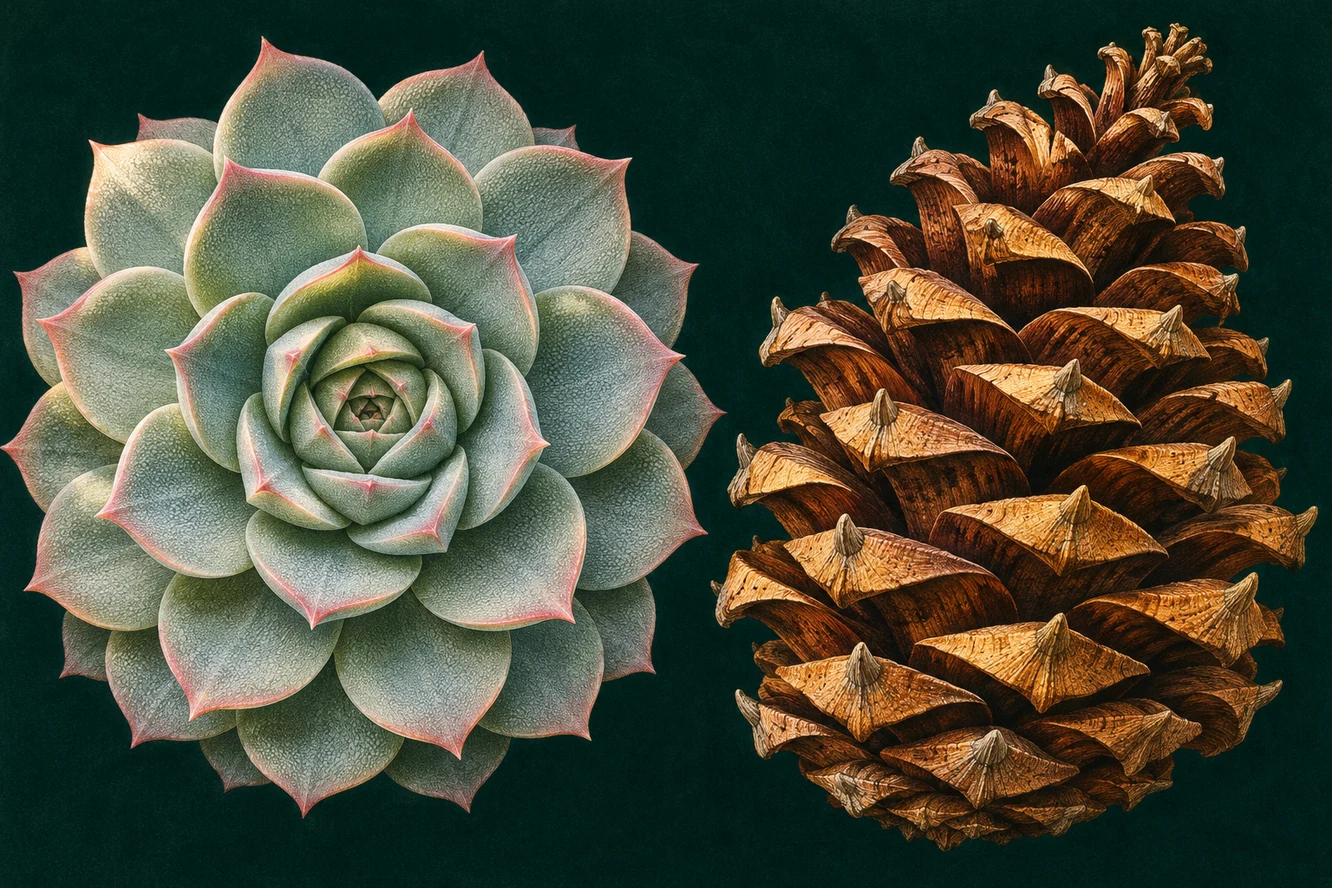
SPEC-01·Botanical Phyllotaxis
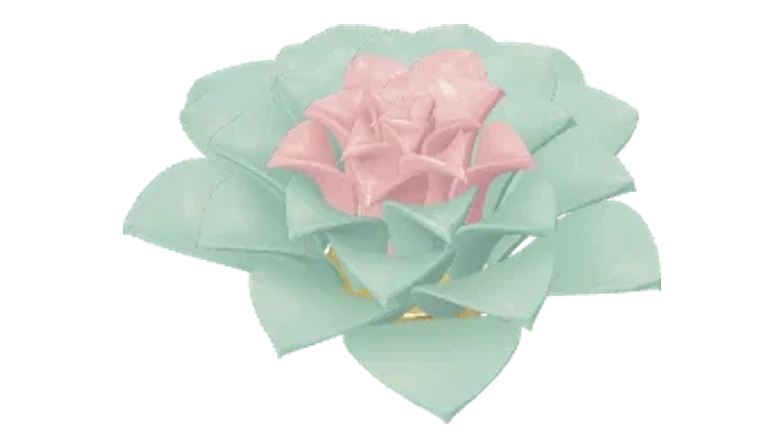
Golden-Angle Succulent Rosette
Follow a row of leaves outward. Can you find a second row turning the other way?
r(n) = c · √n, θ(n) = n · 137.507764°, z(n) = h₀ · (1 - n/N)^γOpen StudyFolio MMXXVI · Nature × Mathematics × Craft
Why are things shaped the way they are? Explore 20 interactive 3D specimens spanning logarithmic spirals, Schoen gyroid minimal surfaces, radiolarian geodesic domes, Japanese kumiko joinery, and compliant flexures.
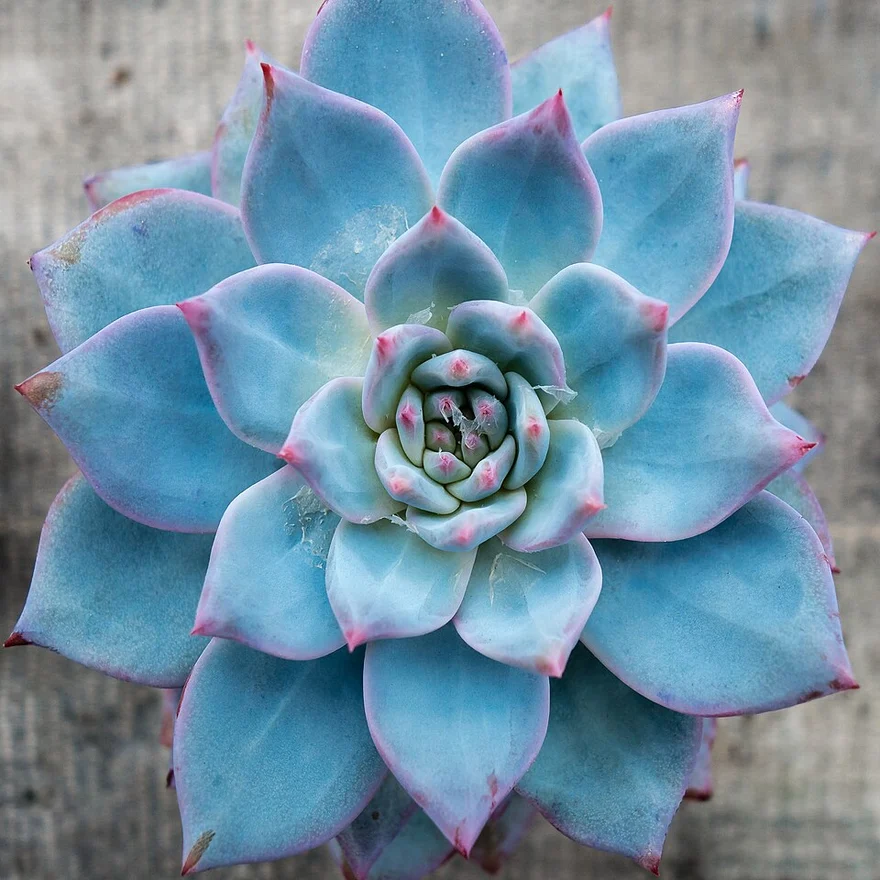
How do the leaves spiral?
SHOWING 20 SPECIMENS
Follow a row of leaves outward. Can you find a second row turning the other way?
r(n) = c · √n, θ(n) = n · 137.507764°, z(n) = h₀ · (1 - n/N)^γOpen Study
Pick one petal and follow its rim until it slips behind its neighbor.
ds² = dr² + R₀² · sinh²(r / R₀) · (1 + ε · cos(kθ)) dθ²Open Study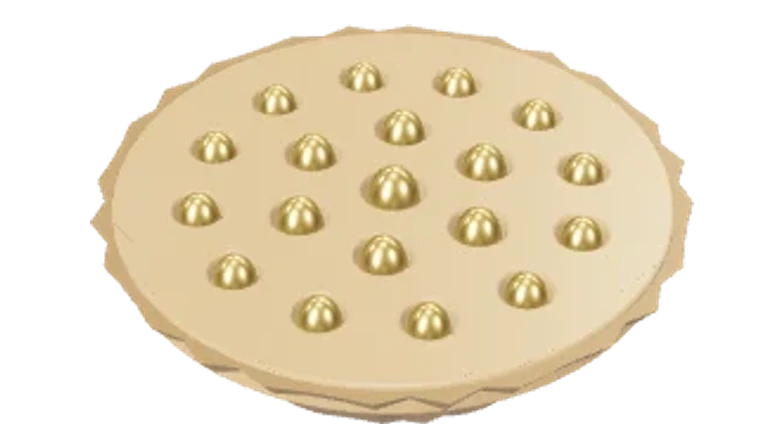
Look into the seed pockets. How much of the pod remains between two openings?
V_i = { x ∈ Ω | ‖x - z_i‖ < ‖x - z_j‖ }, z_i ← ∫_{V_i} x ρ(x) dx / ∫_{V_i} ρ(x) dxOpen Study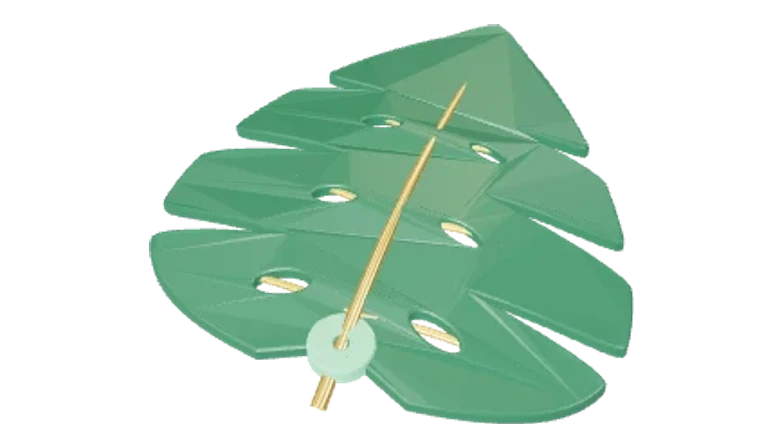
Fold one side across the midrib. Which cuts line up with the opposite edge?
r_p³ = ∑ r_i³, EI(s) = E · I₀ · (1 - s / L)^βOpen Study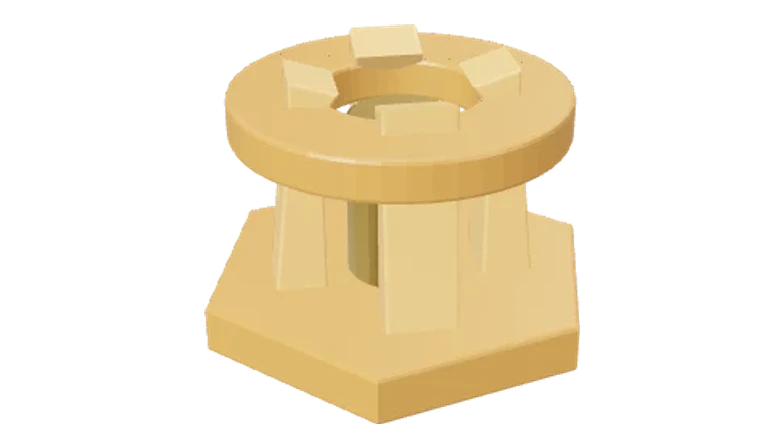
Follow the hook into its socket. Where does the arm need room to bend?
y_max = (1.09 · ε_max · L²) / h₀, F_mating = W · (μ + tan α) / (1 - μ · tan α)Open Study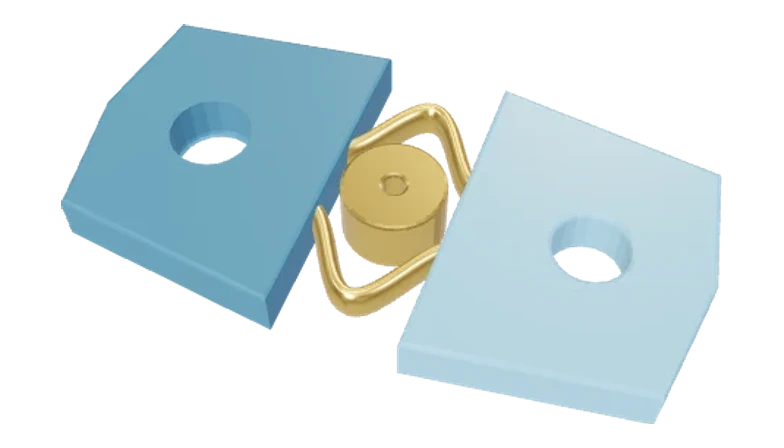
Find the thinnest section. Picture what moves when the two ends come together.
K_θ = (2 · E · b · t_min^(5/2)) / (9 · π · √R), gap(θ) = c_xy · cos(θ) + c_z · sin(θ)Open Study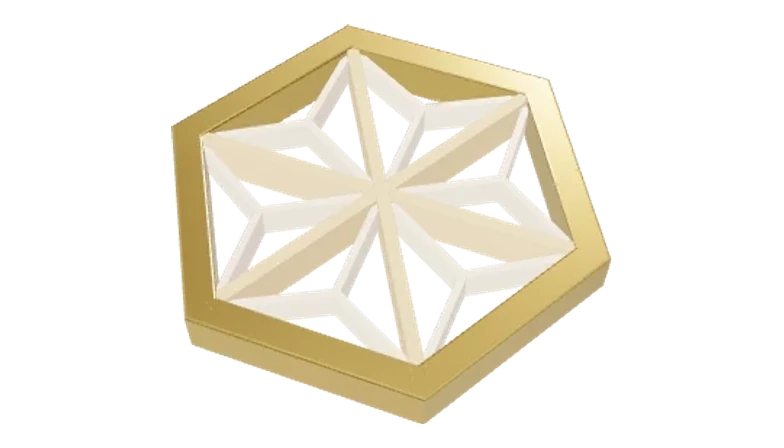
Start with one triangle. Trace the three directions that turn it into a star.
L_infill = a / √3 + δ_preload, θ_bevel ∈ {30°, 60°, 22.5°, 67.5°}Open Study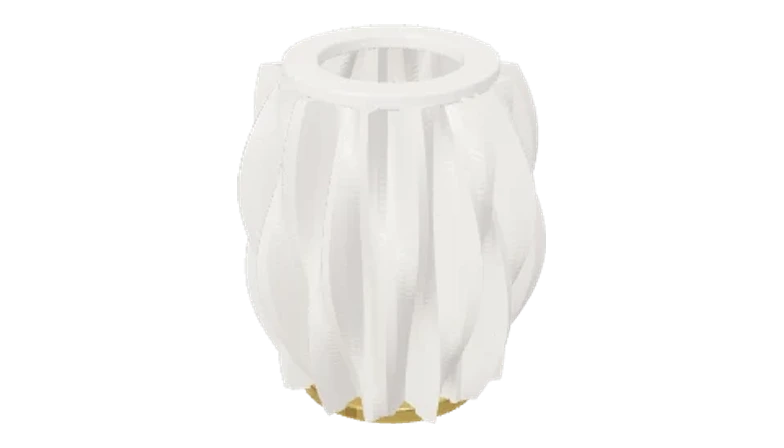
Follow a ridge from foot to lip. Where does it cross a ridge turning the other way?
R(z, θ) = R₀(z) + A₁ · sin(m₁θ + ω₁z) + A₂ · sin(m₂θ - ω₂z)Open Study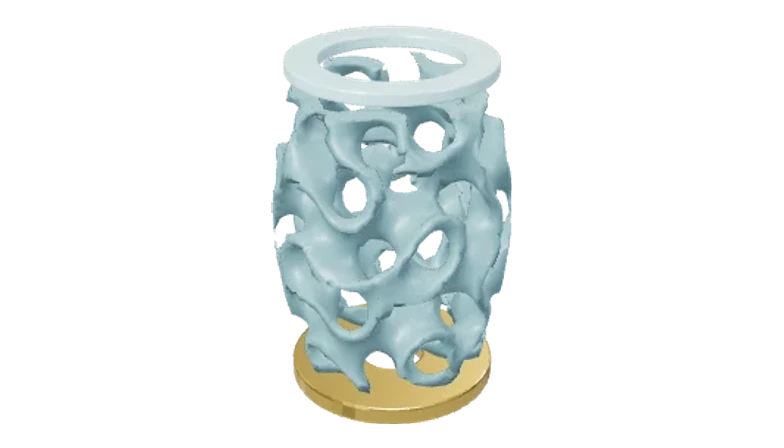
Pick an opening and follow its curved wall into the vessel.
sin(kx) cos(ky) + sin(ky) cos(kz) + sin(kz) cos(kx) = t, H = (κ₁ + κ₂)/2 = 0Open Study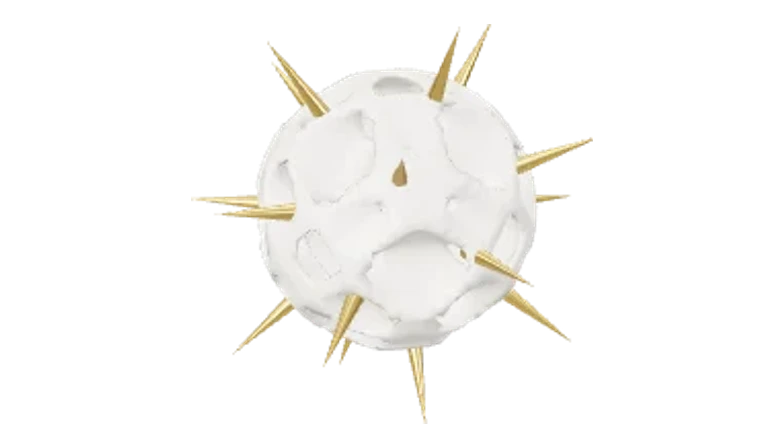
Look around one opening in the shell. How many neighboring openings share its edges?
∑ (6 - k) · F_k = 6 · χ(S²) = 12 ⇒ F₅ = 12, cos(θ_Maraldi) = -1/3 (109.47°)Open Study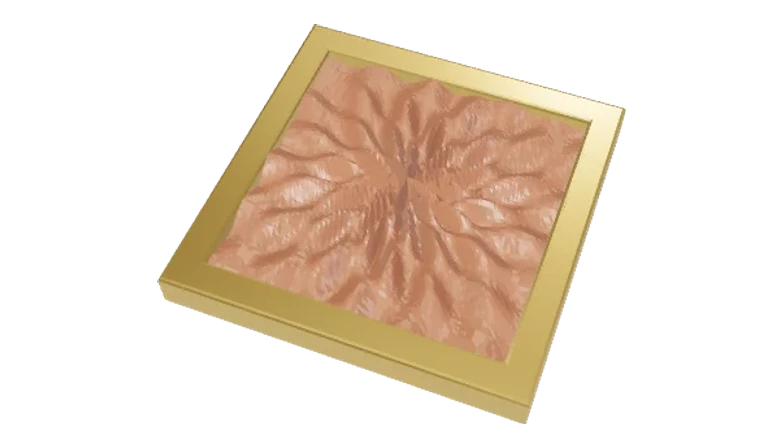
Inspect the color layers. Where does a change in relief also change the thickness of the stack?
T(λ) = ∏_{c ∈ {C,M,Y,W}} exp(-μ_c(λ) · n_c · h_008), z_total = ∑ n_c · 0.08 mmOpen Study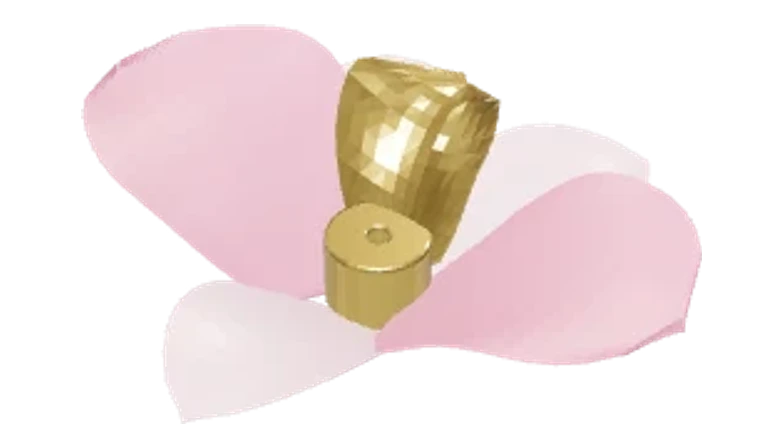
Look beneath the pale outer layer to find the channels that give the petal its veins.
R_d(r) = (α' / 4π) · [ z_r(1 + σ_tr d_r) e^(-σ_tr d_r)/d_r³ + z_v(1 + σ_tr d_v) e^(-σ_tr d_v)/d_v³ ]Open Study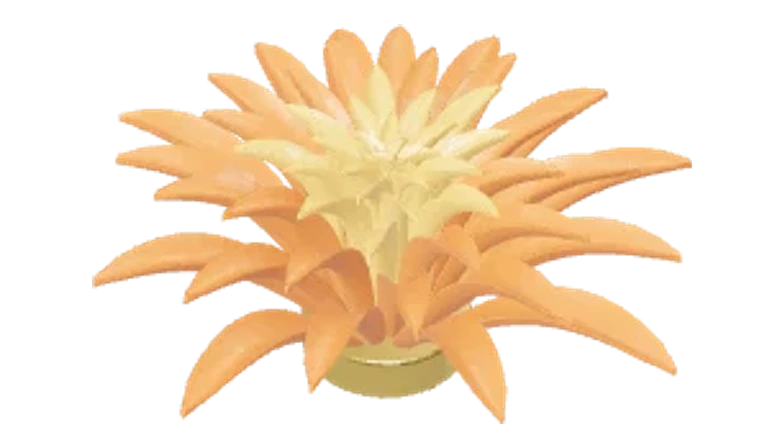
Follow a single floret from its rolled tube to the small spoon at its tip.
r_k(s) = R_base + s · cos(α_k), z_k(s) = s · sin(α_k) - κ_tip · s⁴Open Study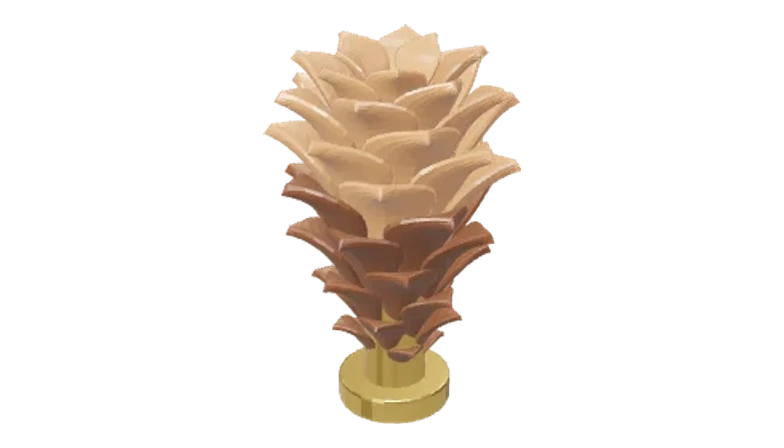
Pick a scale near the base and follow its row as it climbs around the cone.
z_n = n · Δz, R(z_n) = R_max · sin(π · (z_n / H)^0.75), θ_n = n · 137.50776°Open Study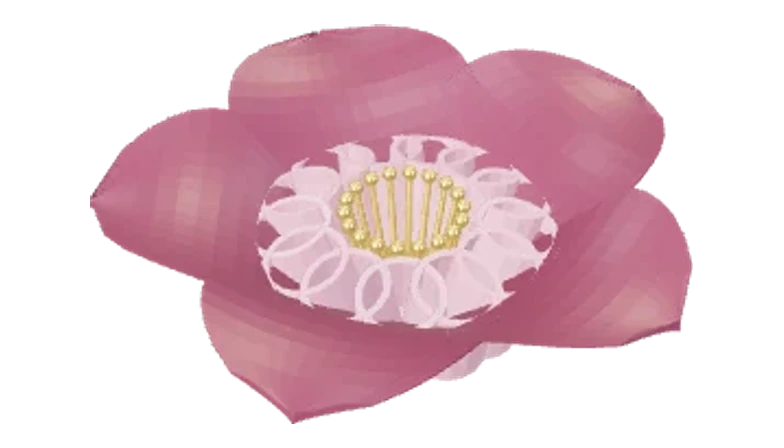
Look inside the five cupped sepals. Can you find the smaller ring around the center?
R_sepal(θ, φ) = R₀ · (1 + 0.22 · cos(5θ)) · sin(φ)^0.85, θ_nectary = k · (2π / 13)Open Study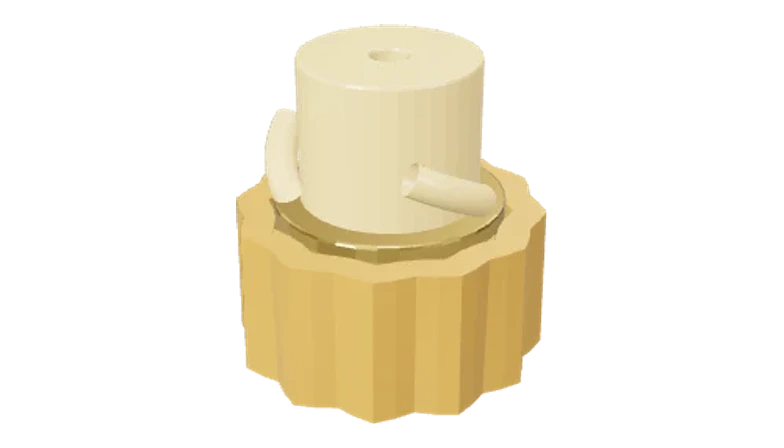
Track one lug through its slot. Where does a straight push become a turn?
z_ramp(θ) = L_pitch · (θ / 60°) - δ_detent · exp(-((θ - 56°)/4°)²), F_axial = k_wave · Δz_preloadOpen Study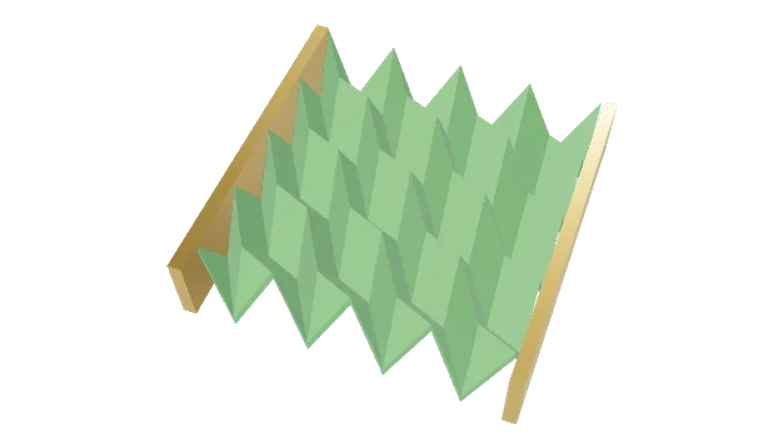
Trace a zigzag crease and look for the neighboring folds that move with it.
ν_xy = -tan²(φ) = -cos²(γ) / (1 - sin²(γ)sin²(θ)), cos(φ) = sin(γ)cos(θ/2)Open Study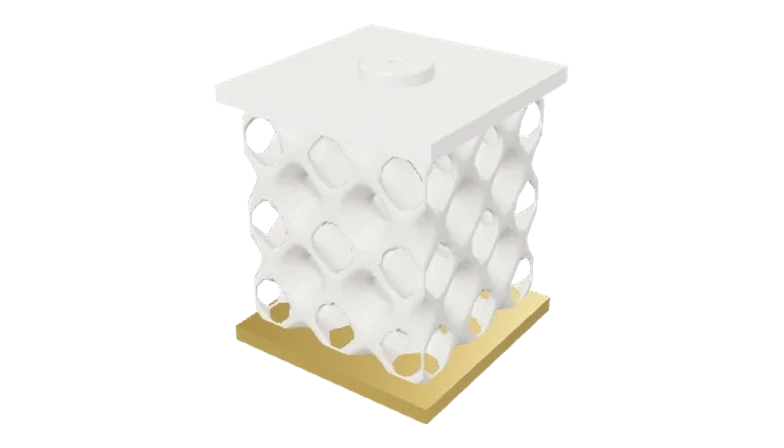
Look through a side opening. Where do the channels meet inside the plinth?
cos(kx) + cos(ky) + cos(kz) = t(r, z), H = (κ₁ + κ₂)/2 = 0Open Study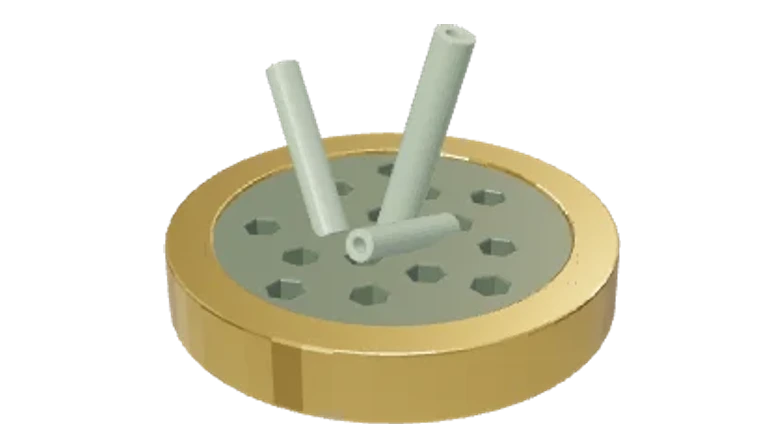
Compare two stem channels. How would their angles change the tilt of a flower?
Δx_cell(k) = h_standoff · tan(θ_ikebana), θ_ikebana ∈ {0°, 15°, 45°, 75°}Open Study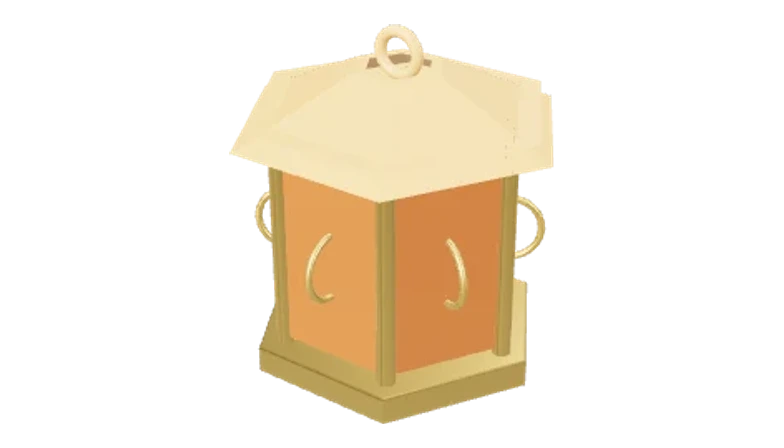
Follow a colored panel to its edge. How does it slide into the lantern frame?
N_swaps(flat) = 4 · (z_max / h_008) ≪ N_swaps(vertical), I_out(λ) = I_LED(λ) · ∏ exp(-μ_c d_c)Open StudyCross-Domain Morphology
Look down on the rosette and follow the leaf tips around its center, or trace a row of scales up the pinecone. Then step into the 12 Universal Archetypes on The Compass of Form to see how the same geometric laws govern Schoen gyroids, radiolarian domes, and Japanese kumiko joinery.