Bilateral comparison
Monstera Fenestration & Venation Struts
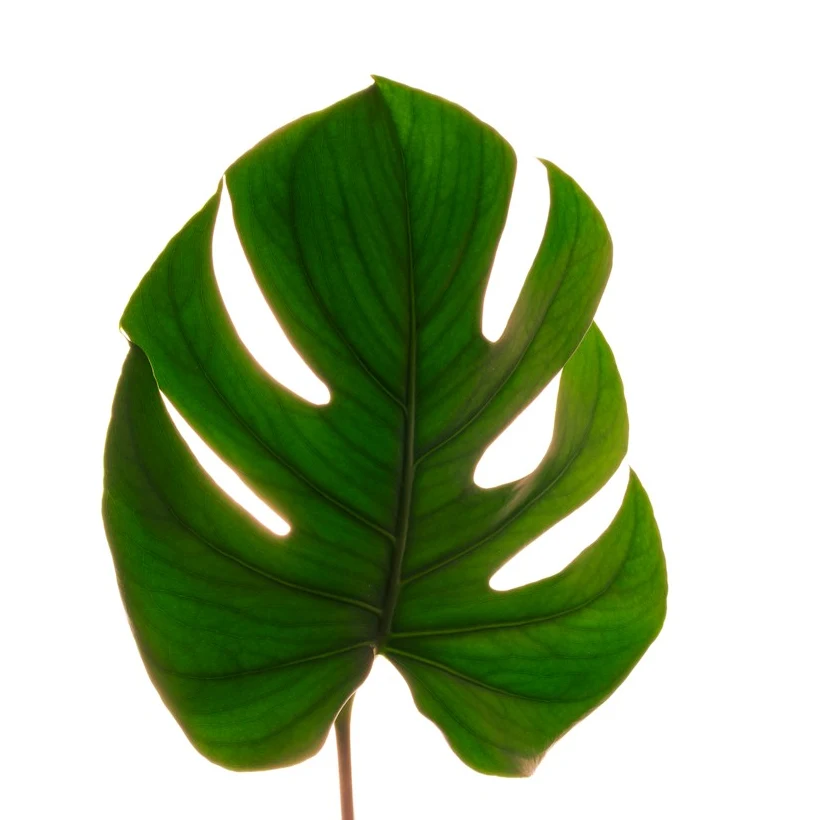
Monstera leaf
Choose a half and drag it across the leaf. Watch the cuts pass one another as the blade turns over.
Photo credit
Valentin, 2026. Unsplash · Unsplash LicenseCropped around the blade and converted to WebP. The fold model uses this leaf’s outline and shading, an illustrated texture and underside.How closely do the two sides match?
Follow the curved midrib from the stem to the tip. The fold uses a straight line between those points. Turn either half over and compare the depth of the cuts along its edge.
Biological morphogenesis and evolutionary structural optimization under physical growth constraints.
r_p³ = ∑ r_i³, EI(s) = E · I₀ · (1 - s / L)^βSymmetry group Bilateral Pinnate Quasi-Symmetry · Genus g = 14 · Euler χ = -26.
A mature Monstera deliciosa lamina acts as a thin-shell structural cantilever supported by a single petiole attachment point. To prevent gravity droop and tearing under tropical downpours, the leaf concentrates structural material into a semi-cylindrical midrib and arched lateral veins whose cross-sectional radii follow Murray's Law: the cube of a parent vessel's radius equals the sum of the cubes of its daughter branches.
Between these primary costal struts, programmed cell death (apoptosis) sculpts elongated elliptical fenestrations before the leaf unfurls. Mechanically, these perforations act like castellated steel I-beams: they shed aerodynamic vortex loads while preserving the continuous outer marginal vein loop that resists edge tearing.
When printed flat on a textured build plate with a stepped 3.2 mm midrib tapering to a 0.48 mm translucent intercostal web, the resulting leaf exhibits authentic anisotropic flex and dramatic backlit veining.
Governing Equations & Manifold Structure
- •r_p, r_i: parent midrib and lateral costal vein radii
- •EI(s): flexural rigidity along arc length s from petiole
- •β ≈ 2.4: biological taper exponent minimizing self-weight deflection
Meridional Shell Curvature, Equilibrium & Interactive Parameterization
Multi-Channel Subsurface Scattering & Optical Depth Stack
Connected Morphological Studies
Cantilever Petal-to-Stem Snap Socket
Euler-Bernoulli Tapered Hook · Anisotropic FDM Layer Mechanics
The canonical mechanical coupling of the Morphologium system: a 2:1 thickness-tapered cantilever snap hook and keyed octagonal stem socket engineered so bending stress never pulls across Z-axis layer lines.
Warm machined-brass ochre color-coding identifies structural couplings across all specimen kits.
y_max = (1.09 · ε_max · L²) / h₀, F_mating = W · (μ + tan α) / (1 - μ · tan α)Open StudyPrint-in-Place Compliant Hinge Joint
Bistable Parabolic Notch Flexure & Rolling-Contact Cone Hinge
Comparing the two primary zero-assembly articulation mechanisms in additive manufacturing: the captive 45° double-cone rolling hinge and the monolithic parabolic compliant flexure.
Steel-blueprint cyan tint highlights elastic strain zones in compliant calibration gauges.
K_θ = (2 · E · b · t_min^(5/2)) / (9 · π · √R), gap(θ) = c_xy · cos(θ) + c_z · sin(θ)Open StudyCMYK Botanical Lithophane Relief Plate
Beer-Lambert Subtractive Attenuation · 0.08mm Layer Quantization
The optical foundation for full-color CMYK additive manufacturing: mapping target OKLCH/sRGB colors into discrete 0.08 mm layer stacks of Cyan, Magenta, Yellow, and Jade-White PLA beneath a variable-height topological relief.
0.08mm layer steps with 100% rectilinear infill eliminate internal air voids and maximize Beer-Lambert color purity.
T(λ) = ∏_{c ∈ {C,M,Y,W}} exp(-μ_c(λ) · n_c · h_008), z_total = ∑ n_c · 0.08 mmOpen Study