Spirals around a cone
Conifer Pinecone (8, 13) Bract Spiral
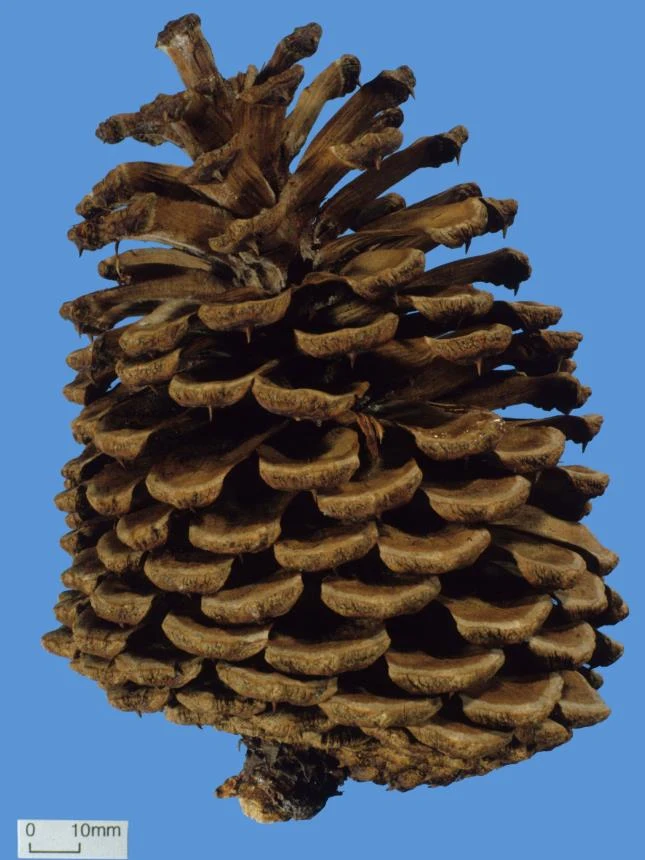
Photo credit
R. Lamberts, 2014. Flora of New Zealand · CC BY 3.0 NZ© Landcare Research. Converted to WebP. The display isolates and tilts the cone. The source retains the studio backdrop and scale card.What changes when a spiral climbs?
Start with the raised tips of the scales. Follow one colored row up the cone, then follow the other in the opposite direction.
Biological morphogenesis and evolutionary structural optimization under physical growth constraints.
z_n = n · Δz, R(z_n) = R_max · sin(π · (z_n / H)^0.75), θ_n = n · 137.50776°Symmetry group Cylindrical Helical Bravais Lattice (8, 13) · Genus g = 1 · Euler χ = 0.
While succulent rosettes and sunflower heads pack primordia onto a flat or slightly domed meristem (producing Fermat's parabolic spiral r = c√n), conifer cones initiate scales along a rapidly elongating cylindrical shoot. In cylindrical coordinates (R(z), θ_n, z_n), constant vertical plastochron spacing Δz paired with the golden divergence angle 137.508° produces a crystalline helical lattice of 8 steep clockwise spirals and 13 shallow counter-clockwise spirals.
Even more remarkable is the pinecone's dead-tissue actuation: each woody bract is a bilayer composite of stiff sclerenchyma fibers on top and highly expandable sclereids underneath, causing scales to hinge open in dry wind and seal shut in rain without metabolic energy.
Our modular translation stacks 13 keyed scale whorls onto a tapered central spline shaft, allowing makers to alternate warm cedar-brown and frosted winter-tip filaments.
Governing Equations & Manifold Structure
- •Δz: axial internode rise per bract primordium (mm)
- •R(z_n): asymmetric ovoid envelope tapering toward apex and base
- •(8, 13): primary parastichy contact numbers on cylindrical lattice
Meridional Shell Curvature, Equilibrium & Interactive Parameterization
Multi-Channel Subsurface Scattering & Optical Depth Stack
Connected Morphological Studies
Golden-Angle Succulent Rosette
Echeveria elegans · Vogel Planar Spiral (8, 13, 21)
An architectural dissection of Helmut Vogel's 1979 phyllotactic packing model applied to crassiacean rosettes, translating continuous primordia divergence into discrete, keyed 3D-printable leaf whorls.
2-layer glaucous celadon exterior over a 0.24mm magenta-rose subsurface core creates natural succulent mucronate tip blushing.
r(n) = c · √n, θ(n) = n · 137.507764°, z(n) = h₀ · (1 - n/N)^γOpen StudyCantilever Petal-to-Stem Snap Socket
Euler-Bernoulli Tapered Hook · Anisotropic FDM Layer Mechanics
The canonical mechanical coupling of the Morphologium system: a 2:1 thickness-tapered cantilever snap hook and keyed octagonal stem socket engineered so bending stress never pulls across Z-axis layer lines.
Warm machined-brass ochre color-coding identifies structural couplings across all specimen kits.
y_max = (1.09 · ε_max · L²) / h₀, F_mating = W · (μ + tan α) / (1 - μ · tan α)Open StudyChrysanthemum Quilled Ray Corolla
Chrysanthemum × morifolium 'Ichimonji' · Tubular Involute Florets
A study of Japanese Imperial Chrysanthemum (Kiku) capitula, where hundreds of rolled tubular ray florets radiate from a hemispherical receptacle along (21, 34) Fibonacci spirals with hooked terminal spoons.
Autumn bronze-saffron exterior transitioning to golden yellow at the central disc capitulum.
r_k(s) = R_base + s · cos(α_k), z_k(s) = s · sin(α_k) - κ_tip · s⁴Open Study